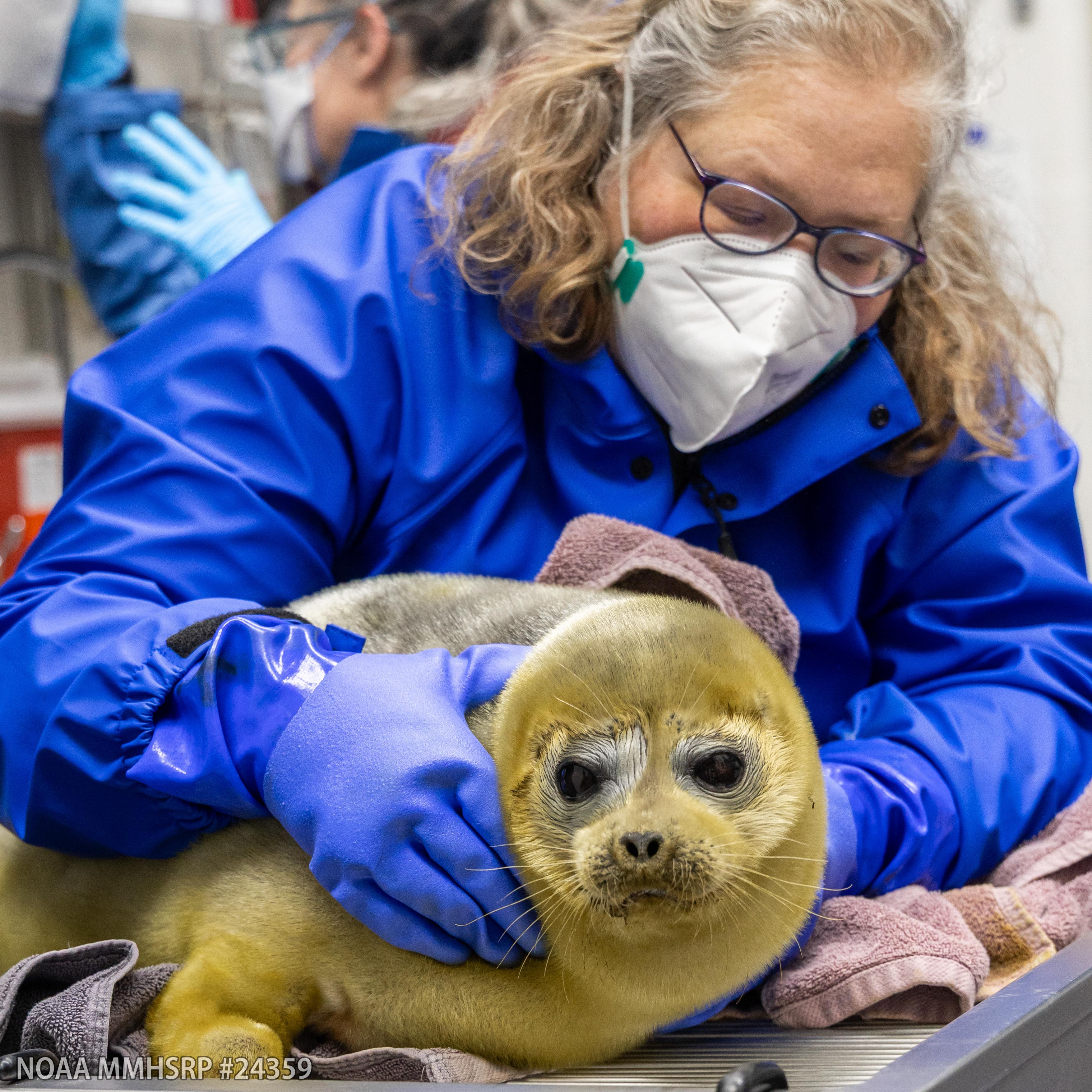
The ringed seal (Pusa hispida) is the smallest and most common seal species in the Arctic. They derive their name from the striking light-colored rings surrounded by dark borders that pattern their silver-gray coats. At the Alaska SeaLife Center, our resident ringed seals provide scientists with a unique opportunity to study the sensory systems and energetics of these highly specialized Arctic pinnipeds.
Master of the Fast Ice
Ringed seals are uniquely adapted to live on land-fast ice (ice attached to the shore) and pack ice. They are the only Arctic seals capable of maintaining breathing holes in thick ice sheets. To do this, they use the heavy, robust claws on their foreflippers to scrape away ice as it freezes, maintaining holes through ice up to 6 feet (1.8 m) thick!
During the late winter and spring, females dig subnivean caves (snow caves built on top of breathing holes in the ice) to give birth to their pups. These snow caves provide insulation from the sub-zero Arctic winds and vital camouflage from predators like polar bears.
Arctic Foraging and Diet
Ringed seals are key players in the Arctic food web. Their diet shifts seasonally and regionally, but primarily relies on:
- Arctic Cod and Saffron Cod — their most important prey
- Crustaceans like mysids, amphipods, and krill
- Shrimp and small fish
A Sentinel of Climate Change
Because ringed seals depend so heavily on stable winter snow cover and sea ice for shelter, pupping, and resting, they are considered excellent sentinels of climate change. Declining snow depth and earlier ice breakup directly impact their pup survival rates.
The Alaska SeaLife Center collaborates on the PHOCAS (Physiology and Health of Cooperating Arctic Seals) project, working with cooperating seals to study their health, metabolic rates, and acoustic sensitivities in order to better predict how they will adapt to rapidly changing polar ecosystems.